
Abstract
The technical, content-related, and dramatic potential of 360° projections opens up a space for experimentation in which we can create more realistic and fantastical worlds, as well as depict and solve more complex problems than with any audiovisual media known to date. Through the spherical projection of information, we gain a vivid representational system that comes far closer to the brain’s processing of spatial-visual data than the available standard image formats. This allows all environmental relationships experienced through the senses and cognitively recognized to be expressed in a visual and auditory manner far more effectively than before. Even though I must limit myself to the visual potential in this article, the common structures between verbal and visual language that I have highlighted are intended to encourage the use of synergies and promote the clarity of messages. The informational potential of 360° projections will influence our communication behavior, environmental design, and intellectual development to the extent that we succeed in understanding the associated sensory-physiological and cognitive requirements and translating them into practical applications in daily life.
How 360° Projections Can Foster the Development of Our Intelligence
The technical, content-related, and dramatic potential of 360° projections
opens up a space for experimentation in which we can create more realistic and fantastical
worlds, as well as present and solve more complex problems than with
any previously known audiovisual media. Through the spherical projection of
information, we gain a vivid representational system that comes far closer to the brain’s processing
of spatial-visual data than the available
standard image formats. This enables us to articulate all environmental relationships—those experienced through the senses and cognitively
recognized—in a much more vivid and
auditory manner than ever before. Even though I must limit myself to the
visual potential in this article, the common
structures between verbal and visual language highlighted here are intended to encourage the use of synergies
and enhance the readability of our messages. The informational potential of 360°
projections will therefore influence our communication behavior,
environmental design, and the development of our intelligence to the extent that we succeed in
understanding the associated sensory-physiological and cognitive requirements
and translating them into practical applications in daily life.
This near-perfect immersion poses major
challenges to our visual perception, our
vivid imagination, and our spatial thinking—challenges that we cannot adequately address simply by transferring our concepts from
working with conventional rectangular visual media. Gesture,
typography, topos, and perspective in conventional visual media are optimized for the frame
, within which the entire action is condensed as if on a stage
. The viewer
immerses themselves in this precisely delineated area of action, remaining largely passive
in the sense of a selective search for information, while constantly suppressing their own role in the communication process as well as the
events taking place around the edge of the visual medium. What happens
to us when we suddenly no longer perceive this boundary? How do we react,
when we ourselves suddenly find ourselves on stage and become part of the action
? What new possibilities does this open up for media theorists,
media designers, and media users?
The human genome has not changed significantly in the last 100,000 years.
Cultural evolution is therefore largely based on the development of
spatial communication systems, which we use globally and
across generations in the form of our settlements,
infrastructures, knowledge archives, artifacts, languages, and networks. Every innovative, vivid
presentation technique therefore inevitably leads to the further development of our
visual intelligence, which—thanks to the plasticity of our brain structures
—can be cultivated throughout our lives. Spherical 360° projections require new formal,
content-related, and dramaturgical strategies for working with visual media, which in turn
entail profound changes in the auditory domains of language, sound, and
music. This article aims to raise awareness of the complexity
of this topic and to highlight the challenges it poses for our
conception of space.
Why We Construct Space in Our Brains and Perceive It Around Us
We cannot perceive the environment objectively, since we can only develop a practical conception of it—one that is limited by the capabilities and
genetic disposition of our nervous system. The nervous system consists of
a central and a peripheral part, which together form a self-referential
system that generates information through internal and external communication processes
. At the center is the brain, while the
periphery forms the boundary between the body and space. The activity in the
retina of our eyes controls the generation of information in the brain, which in turn
affects these processes and the body’s overall state. Everything is connected to everything else through the
neural pathways, which is why every internal change leads to
a restructuring of the visible world just as much as external events or our
own actions do.
Color and light are not universal quantities, but rather human
perceptions that we experience as phenomena. Through the manifestations
of our living space, we have access to the energetic potential of the environment,
which we constantly utilize for the survival and cultural development of our
species. Our cognitive abilities develop in accordance with
our practical skills and abilities to use the
individual sensory systems in the process of cognition and communication. From
further research into the physiological foundations of human
vision to the regions of the brain capable of conscious processing
, it has become clear that this is a specific form of
cognitive activity. Vision is a consciousness-forming process,
the result of which is represented in the neural structures of our nervous system
. This makes it clear how we learn about our natural and sociocultural environment through spatially-visual
information and how
, as our knowledge increases, so does the capacity of our
brain. The structures of this neural model of cognition are currently
the subject of one of the most exciting debates in the
sciences. According to some representatives of the neurosciences, such as
Gerhard Roth and Wolf Singer, the “world in our heads” merely reflects the
interim result of an intercultural and cross-generational
construction process.
The representation hypothesis, which is now widely accepted in the field of neuroscience
, shows that in the course of their
individual development, every individual constructs a subjective reference model of their own
reality based on the consequences of their actions. Modern
imaging techniques, such as magnetic resonance imaging (MRI), allow us
today to gain initial insights into how our brain functions, as we can visualize the neural
response to mental and emotional processes. However,
not only the images we show our test subjects, but the entire space
around us, are constructs of our brain that we project into the external space of the
environment. We can only perceive the environment through the filter of our senses
, even though it is the source of our perceptions and the matrix
of our actions. Both the spatial nature and the
interactive possibilities of spherical 360° projections point to a path
through which we can visualize how our brain works, as if in a mirror
. If 360° projections are systematically used for research and innovative
applications, this could provide many further impulses in the future for
the further development of our ability to think spatially.
How 360° Projections Become Powerful Spatial Speech Systems
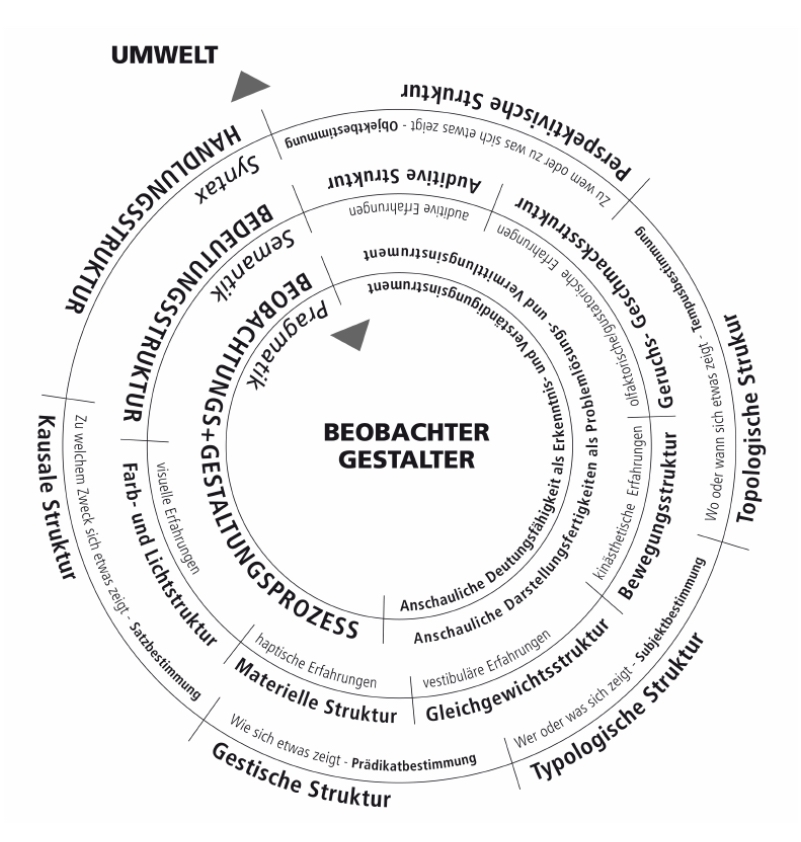
The organization of the space of visual perception and imagination is reflected in the semantic structure of meaning and the syntactic structure of action in verbal language. The “grammar of seeing” is, evolutionarily speaking, far older than the development of verbal language, whose principles are based on our visual perceptions and the ways they can be linked. Our cultural space exhibits a far higher degree of linguistic pre-structuring than the natural world, since we have adapted it to our needs across generations through the processes of observation and design. Our settlements, everyday objects, works of art, and communication media have evolved through a continuous process of mutual understanding. We can therefore discern how our brain constructs space by examining the cultural transformation of the natural environment. The cultural environment is designed in such a way that all places and objects provide us with vivid information about their location (topos) and their intended use (typos). From birth, we construct within our brains the “visual space” as a meta-representation of all meanings experienced through the senses. The connection between the visual sign and the content it denotes makes it clear why we perceive materials, forms, structures, proportions, smells, sounds, emotions, behaviors, and contexts of action—and why we can express them visually, physically, and spatially through vivid cultural techniques. For us, the visual space is not merely one sensory space among many; rather, it forms the shared horizon of meaning and significance for our haptic, kinesthetic, vestibular, acoustic, gustatory, and olfactory experiences. It is a causal descriptive model in which we systematize all experienced effects arising from the process of multisensory engagement with the environment according to the principles of causality, contingency, and probability. We project the causes onto the environment, which is why we no longer perceive its manifestations merely as phenomena of color and light, but as meaningful components of a sign system. What repeatedly unfolds before our eyes as we act and react with all our senses generates the causal relationships between the spatial-visual signs and their semantic meanings. We continually update this associative structure of our perceptual space throughout our lives so that it remains as consistent and comprehensible as possible at all times. The discovery of the semantic relationship between a spatial-visual sign and the meaning it denotes is the prerequisite for its syntactic linking to the context of the communicative situation. Even in spoken language, a single term remains disconnected until the listener can deduce its meaning from the way it is used in a sentence or from the context of the situation in which it is used. The conception and design of 360° projections should therefore be based on the linguistic structure of the visual signs. A view into the panoramic dome reveals not merely an image, but a spatial sign system through whose semantic and syntactic structures a targeted dialogue with the target audience can be initiated and shaped. The lasting impact of any message is reflected in the intellectual and emotional insights that the target audience takes away from the experience. The unique communicative potential of 360° projections is only revealed when we develop it as a medium for insight, understanding, problem-solving, and mediation. The new aesthetic naturally follows the function of language, as has been demonstrated to this day by every communication technology. All signs in the visual space are interconnected through their meanings, which is why nothing can be added or removed without altering the message. To ensure that the content and its overall message are perceived, the treatment of elements within the projection space should be as minimal as possible. Aesthetics is not an end in itself, but a function that serves the legibility of our ideas!
Why Our Vision Can Only Be Explained in the Context of the Communication Situation
The eyes transmit the pre-structured color and light signals via our
optic nerves to the brainstem, where—after approximately 60 milliseconds—they are compared with
all other sensory data arriving simultaneously. As a result,
innate behavioral patterns and
reflexes are activated after only about 100 milliseconds. In this phase, we do not yet perceive any specific details of the
environmental situation, as our physical state involuntarily and unconsciously
prepares for the expected event. 360° spaces always have an atmospheric effect, since
our state of arousal and emotion attunes not only to specific content but
also to phenomena such as color, light, sound, form, and movement. Everything
we do or don’t do in 360° projections affects the viewer. Is it light or dark at the
beginning or during a scene change? Does the first
event appear monochrome or polychrome to us? How quickly do the movements begin?
Do we see shapes right from the start, or do we first immerse ourselves in the atmosphere?
Do we hear something before we see it? Are intelligible words and music conveyed to us at
, or do we first experience a soundscape or a
sound space?
In the visual cortex, the signals coming from the eyes are further processed
and routed via two main processing streams in parallel to our memory areas
. The “Where stream,” which leads to declarative memory, serves
the perception of movement, action, and position, while the “What stream,” which leads to
semantic memory, enables us to identify things
based on their meaning. Every event in the visual space is therefore evaluated, on the one hand,
based on its contextual meaning, and on the other hand, based on its role in
the context of action within the entire presentation situation. Not only what we project,
but also where we place something, who it is close to and who it remains distant from
, where it comes from and where it is moving toward—all of this has formal, contextual, and
dramaturgical consequences for the message.
The results of our interpretive activity can be ambiguous, which is why another
processing step follows in the brain until we can actually see the result of the
information generation in the brain in a spatial-visual form
. The visual data streams originate and terminate in the brain’s motor and
emotional control centers.
In the final processing step, the generated information is evaluated, which
determines which information ultimately enters working memory.
Our working memory, whose content is determined by our conscious visual
perceptions, has a
very limited storage capacity compared to long-term memory. Here, a comparison with a computer is apt:
in which data must be loaded from the much larger hard drive into
the working memory for processing. In this process of filtering
potential information, reason plays just as much a role as emotion, although ultimately
one criterion is of decisive importance: What does not interest us,
we simply do not perceive! All perceptions that are insignificant or irrelevant to us are suppressed and remain in the background consciousness.
By selecting meaningful information, our brain protects itself from
sensory overload, which has ensured the survival of our species to this day.
This relationship has a significant impact on the design and implementation
of 360° projections, in which controlling attention is far
more difficult than with conventional formats.
From Movement Dynamics to a Trail of Action
Because of our ability to track moving targets, we must forgo the
total spatial awareness that rabbits, for example, experience. Their eyes, located on the sides of their heads with their fields of view overlapping at the front and back, provide a 360° field of view. However, this ability to see in all directions significantly reduces the spatial resolution of the field of view when compared to species that have movable eyes. This
panoramic field of view is associated with a reduction in all information regarding shape, color, and
movement. Humans, on the other hand, due to their two
closely spaced eyes—whose retinal areas, moreover, cover only a tiny field
where the projected content appears high-resolution and sharp—can fixate on only a
2° section of their surroundings. It is only through eye movements
that the individual fixations are linked into a continuous sequence of events. The
entire peripheral area of the retina serves to guide the gaze, which is why
it is sufficient for this area to have far fewer receptors and therefore
remain only a vague outline. The best way to visualize the static retinal image is to imagine it as a
large, constantly fogged-up windowpane through which only a diffuse image
of the surroundings penetrates, while a tiny clear spot appears in the center. With
our eye movements, we trace a path through the diffuse field of
shadowy events, which allows us to perceive clearly visible
images exclusively during periods of rest. Due to the high speed of the fixations
and the delayed response of the perceptual system, we have the impression
that a spatial, moving, colorful, sharp, and
detailed image of our surroundings is present before our eyes, opening up a scope for interactions
.
The evolutionary advantage of closely spaced, mobile eyes lies in the ability
to track moving targets. From the vector data, our brain calculates
familiar action patterns and movement trajectories, which gives us the ability to
anticipate. It is no coincidence that the type of eyes with a narrow interpupillary distance
is found predominantly in predators, whose brains can anticipate the movement intentions of their prey—which is usually
faster and more agile—allowing them to plan
and optimize their actions.
For the 360° projection, the movement dynamics of the image hold
particular significance, as they dictate both the narrative thread and the
dramaturgy of the story, thereby guiding the viewer’s
expectations. The spatial and temporal conception of events throughout the
entire 360° projection space determines the viewing patterns of our target audience,
whose line of sight we can thus guide from a distance. Both the places
where our gaze lingers unusually long and the trail we trace with our
eye movements give others insight into our
thoughts and feelings. Some of our intentions are foreshadowed by our
anticipatory gaze, through which we mentally anticipate planned actions before carrying them out
. Every visual event marks a
behavioral state and a trail of action that unfolds before our “mind’s eye” from the past through the present and into the future.
How the Visual Field and Field of View Determine Spatial Perception
The field of view that humans perceive as natural is approximately 50°, since their
eyes have maximum mobility within this range and can therefore perform
rapid fixation movements for long periods of time. We are so accustomed to this that
this angle has become the standard focal length for all camera lenses and projectors
. Even when viewing images, we intuitively orient ourselves to this
distance and, depending on the size of the exhibit, position ourselves at a corresponding distance
. We sense when we fall short of or exceed this angle, which we can consciously induce or correct
by adjusting our viewing distance
. If a viewer’s vantage point is fixed to a specific field of view—such as
by requiring a seated position—the size of the projection surface
must be adjusted accordingly. Only then can the viewer
take in all the content relevant to the narrative within the available time. If the image format is larger or
our viewing distance is too short, the peripheral areas disappear into the peripheral
field of vision, which spans approximately 180° horizontally and
about 130° vertically, of which 60° lie above and 70° below the image horizon.
While the resulting image format has become established through standardizations ranging from the
“Golden Ratio” to DIN standards, there have been—and continue to be—
deviations from this ergonomically based
standard for millennia. Whenever images are used to fill a wall or even an entire room,
the viewer finds themselves right in the middle of the virtual scene.
As a rule, however, we typically use only the so-called
functional field of view, which covers just a 40° section of space. To
avoid signs of fatigue, we move our eyes only within a
radius of about 20° to the right and left of the designated focal point. In the
vertical direction, we look up by 10° and down by
30°. While this limited field of view can be easily accommodated
in standard formats by positioning the composition centrally and at a slight distance
from the edge of the image, a
completely new approach must be found for 360° projections. The problem can be illustrated with an example
. During a tennis match, spectators sitting parallel to the net
can either follow the action on one side of the court
or focus their attention on the ball’s path, which requires them
to constantly turn their heads. Only the wide-angle shot from a
television camera allows us to maintain an overview, as it presents the entire action
in a standard aspect ratio. Since in panoramic
spherical projection spaces we can simultaneously
survey only a circular field of about 40°, we can see the remaining 320° of the action only through deliberate
head turns, which require sufficient freedom of movement and a significantly
longer reaction time. From this perspective,
confining the viewer to a fixed seat or standing spot is counterproductive. Just as in
a painted church interior, we want to let the unique atmosphere
wash over us and move freely throughout the space. The innovative potential of 360°
projections lies in the infinite variety of perspectives, which can significantly expand the scope for
creative expression and interpretation. For the conceptual design of 360° projections—in terms of content,
timing, and dramatic structure—the
field of view is of crucial importance, as it serves as the window into the
consciousness of the viewer. If events change too quickly, this has the
same impact on the understanding of the vividly conveyed message as a text spoken too quickly. If they are too far apart,
the viewer must decide which event to focus on and which to
ignore. For any design of 360° projections, the following principle therefore applies: What we
cannot take in at once—both temporally and spatially—we do not understand!
Why “Guided Reading” at an Optimal Reading Speed Is Useful
The motor ability for involuntary, stimulus-directed eye movements—which is already established prenatally
—forms the physiological prerequisite for the
development of our brain’s spatial-visual functions. Voluntary eye movements
, on the other hand, reflect the level of knowledge we have already acquired. For reasons of
efficiency, we increasingly use our eye movements to scan the color and light patterns in our environment that are already
meaningful to us in terms of content. Our
eye movements “trace” our train of thought and express our interest
in the surrounding situation. A gaze that wanders aimlessly, on the other hand, indicates
our lack of interest in the external perceptual space. As soon as our
attention is focused on the train of thought through our inner
mental space, our gaze therefore appears vacant and absent.
Eye movements can be understood as a vivid form of reading competence,
since we derive meanings,
behavioral states, and contextual relationships from the spatial-visual sign structure of the environment. For this
reason, eye movements—whether when reading texts or
viewing images—serve as an indicator of the viewer’s visual literacy,
which can also be used to distinguish experts from
laypeople in the context of the communication situation. A gaze that wanders aimlessly is usually a
clear indicator that the reader or
viewer is either overwhelmed or underchallenged.
While our eyes can move within the functional visual field
in a fraction of a second, turning the head takes significantly longer. While we
at least notice when something
happens in our peripheral field of vision of about 180°, we do not perceive at all the half of a
panoramic projection that lies behind us from our vantage point. If something significant
occurs here, it must be communicated to the viewer through guiding image movements or auditory
signals so that a head turn can be initiated.
Only then can the narrative thread be followed or resumed. With 360°
projections, it is crucial to take into account the viewer’s extended reaction time
. Only if the viewer has the opportunity to
follow the narrative thread will they maintain a lasting interest in the events
and understand the message. The vast potential for information and experience
offered by 360° projections can therefore only be fully realized if all those involved in the creative process
have gained practical experience through hands-on experimentation
.
What We Can Learn from Eye Movement Patterns
The patterns of voluntary and involuntary eye movements in our target audience are the key to understanding 360° projections, upon which all design and implementation should be based. While our gaze is involuntarily drawn to emotionally significant content in the projection scenario—content that stems from our instinctive needs—we can control voluntary eye movements solely through the viewer’s interest in the form, content, and dramatic structure of the narrative situation. Therefore, whether we are reading or looking at objects, our eyes linger for about 50 milliseconds on the meaningful signs we have already recognized before moving on to the next event. Within the functional visual field of 40°, we can therefore process about 20 locations per second through rapid fixations, although the
reading speed slows down significantly when dealing with content that is difficult to understand.
Only during the resting phases between the jerky saccadic
eye movements can we consciously perceive meaningful characters in the visual field
, since our eyes must repeatedly refocus on the event
. Exposure times shorter than one second per frame usually result in
a complete inability to comprehend the content, though this may unconsciously trigger reactions and
vague memories. Faces,
hands, and other human body parts, as well as semantically distinctive shapes,
colors, and movement patterns, are typically perceived quickly.
Planning dynamic projections is a challenge even with conventional
image formats, as viewers react with uncertainty, confusion, and
ultimately frustration when too much is happening at once. This sensory overload
is easy to understand when the reading speed of a text
is disproportionately increased or when several books are recited simultaneously.
Furthermore, when a viewer stands inside the spherical dome of a 360° projection,
the extreme prolongation of the time required to
rotate their head and body must also be taken into account. The simple transfer of content
from conventional image formats to 360° projections therefore almost certainly
overwhelms the viewer and should, in principle, be adapted to the
limitations of our perceptual capabilities.
Where the line between the real world and immersion lies
360° projections allow us to create nearly perfect
immersive experiences, since the entire scene does not have to be crammed into a small section of the image
but can unfold freely throughout the entire space
. For a believable and emotionally impactful immersion, the
perspective structure of the image projection must be aligned with the viewer’s vantage point
and dynamically adapted to their movement matrix. The
perspective structure of the entire projection space is governed by the dynamic
relationship between the viewer, the events being viewed, and the
light source. The viewer’s position determines the center of the perspective
structure. Every change in one’s own vantage point within this
spatiotemporal system of order brings with it a new perspective on the object
of observation. By defining our perspective, we convey our point of view to the viewer and dictate the direction in which they should read. The
author of a visual work therefore always forms the subject in the
creative process, who inscribes upon the object his or her perspective for solving the problem associated with
the work’s purpose. In the
interpretation process, on the other hand, the viewer is confronted with the designer’s perspective
through the work and is invited to explore the designer’s world of ideas.
Due to the wide variety of possible viewer standpoints
and viewing perspectives, 360° projections are extremely ambiguous and thereby open up many
opportunities for us to form our own standpoint, as well as to question
our own perspective.
If it is not possible to trace the perspectival structures of the entire projection space
, immersion can only be achieved if the viewer cannot find a
horizon. The view of outer space, as we experience it in a planetarium, presents an ideal immersive space, since—due to the vast distances involved—we no longer perceive scale, proportions, depth, or the shapes of objects and space in a perspectival manner. Looking up at the sky or diving beneath the water’s surface also places us in spatial situations where the horizon slips out of our field of view and therefore no longer serves as a meaningful point of reference. Yet even if we succeed in continuously adapting the perspectival structures of a 360° projection to the viewer’s vantage point, there is a physiologically determined limit that prevents complete immersion. Through the accommodation of our eyes’ elastic lens to the necessary angle of refraction of the light rays, the brain’s motor center receives real depth information. This allows the optical conditions inside the eye to be adjusted to the distance
between the viewer and the fixed target. The distance between the ocular point and the point of focus
is thus constantly measured, providing our brain with real 3D data.
The optical conditions within the eye are maintained at a constant level in this way,
which we replicate with a camera by dynamically adjusting the image sharpness
. Contraction of the ciliary muscle causes a reduction in its
circumference and a concentric narrowing of the ciliary body. This increases the
refractive power of the lens, resulting in near accommodation.
Relaxation of the ciliary muscle leads to distant accommodation of the relaxed
ciliary body. In this way, the brain is also able to calculate a
constant size, such that the objects in the perceptual situation
do not change their dimensions as drastically as can be observed, for example, when
a projection screen is moved relative to a projector. For this reason, people,
objects, and spaces do not exhibit converging lines.
More significant objects appear larger and closer to us than the surrounding context. In a
360° dome, the curvature of the lens in the eye remains virtually unchanged, since the
distance from the viewer to all spatial planes of the image projection remains constant
. This phenomenon cannot be completely eliminated either by 3D glasses or by deliberate
blurring, motion parallax, fading, color shifts, or
perspective distortions. Even if one disregards
the audible boundaries of the projection space—which are captured by room acoustics
—the lack of lens curvature remains a constant indicator of the
illusion. It is precisely here that a boundary becomes apparent between real space and the level of immersion achievable through a 360° projection
.
Why Are Nonlinear and Interactive Communication Techniques Needed?
With conventional image formats, the narrative structure is inevitably linear, since we always keep the entire action in view at any given moment (
). This linear structure (
) allows us to use cuts that can be arranged arbitrarily along the timeline (
) through flash-forwards and flashbacks. In principle, we read these images like the pages of a
book, in which the author is bound by the flow of words. Our
reality, however, resembles neither a book nor a picture, since we find ourselves
in the midst of a spherical space whose structure of events extends around us
all the way to the surrounding panorama of the horizon. While our
view is always confined by a window frame in standard image formats,
with spherical 360° projections we find ourselves in the midst of a vast landscape,
over which the sky stretches. The interior space of a conventional
image becomes a landscape that requires entirely different strategies of thought and action
. The positive formal principle, in which we situate all things within the
boundaries of the picture frame, gives way to a negative principle, in which the viewer has a choice among a multitude of events.
Through 360° projections, messages can be conveyed in a nonlinear form
, fundamentally altering the relationship between space and time.
Through the panoramic curvature of the narrative structure, the beginning and
end can merge into one another, enabling us to create visual representations of recursive
processes and infinite diversities. On the closed
timeline, closed systems can be generated whose
dynamics of change the viewer can follow in both directions. Since we
can only ever perceive a section of 360° projections, the
viewer can use this unfamiliar freedom in a creative way. When the
viewer is given the opportunity to choose between different interpretations, they can
construct their own story from a multitude of possibilities. Just as with the
nightly view of the starry sky, which has always offered humans ambiguous
constellations and thus multiple interpretations, we must decide on a
perspective. By choosing our points of reference, we determine whether we
see birds, flying objects, constellations, satellite and planetary systems, nebulae,
galaxies, or universes. This opens up entirely
new formal, thematic, and dramaturgical possibilities for media
design.
In my view, however, the greatest advancement in the field of spatial-visual communication lies in the fact that the viewer himself or herself plays an active role in every 360° projection. Unlike with conventional media formats, we are not outside but in the midst of the visual space, which completely surrounds us at all times and from every
vantage point. From our central position in the
panoramic visual space, we can establish visual connections
with any event and break others, thereby personalizing the message. Through
our reception patterns, we weave our own associative
networks of meaning, which can lead to surprisingly new actions, questions, and
answers. Using 360° projection systems, we can organize the visual space
for the first time in a way that corresponds to the functioning of our
brain. To this end, the viewer must have the freedom of choice
—just as in real space—to decide between the information presented simultaneously. In
real space, we can generally choose for ourselves which path we
want to take. As a result, every action can take an unexpected turn, through
which we can arrive at new goals and innovative solutions. 360°
projections expand our freedom of thought and action to the extent that
processes can be influenced and shaped
through interactions and choices.
How 360° Projections Can Generate Knowledge and Shape Reality
We cannot fully comprehend the environment itself because it is the cause of our
brain development. Our conceptions of reality achieve a high
degree of intersubjectivity and functionality, since we constantly call them into question through dialogue with the
environment and thereby continually update them.
The reality of our living space therefore describes that part of the environment which we
can access through the development of our imagination, our perceptual abilities
, and our creative skills. Every learning achievement is based
on the neural networking of our concretely acquired knowledge according to
the causal principle of cause and effect. Therefore, we always perceive a
purposefully organized world in which things behave as we expect them to.
If they do not, we seek the reasons and adjust our expectations. Through this principle of empiricism, we create knowledge in a vivid
manner. The visible works of the natural and cultural world are therefore
not simply there for us, but they tell us about the “invisible” workings of the forces,
which we hold responsible for their creation. The principle of production conveys to us the intentionality of a work—its purpose of existence or use.
Technical innovations bring about changes in the reality of our lives. Through
them, we can expand the limits of our sensory systems and generate information from
complex environmental data. Cultural evolution is therefore based
on the development of spatial communication systems. It is precisely
here that the innovative potential of 360° projections lies for sensory
perception, mental visualization, and the practical shaping of our
reality. If visual contact with a vividly depicted
situation is missing, our brain’s performance is greatly reduced, since
only the memory content that can actually be retrieved can be used for mental processes
. We can easily
visualize this information deficit by trying to imagine the appearance of the people
we encounter every day. Who could spontaneously draw a
portrait of these people? Through intensive practice, we transfer this
information into memory systems that we can access more easily. Yet the
rule remains that we use the entire environment as a “visual
memory store.” Our brain works efficiently and adapts to
environmental conditions. Why should it reserve information—and thus storage space
—when it is constantly available all around us?
Unlike conventional image formats, complex details do not necessarily have to disappear from the screen in
panoramic projections.
Outside the field of view lies a broad horizon where they can remain present and connected to current events via
. If necessary, the viewer can
reorient themselves at any time and, using the visible
interconnection structure, carry out far more sophisticated thought and action processes
. This approach makes it possible to simplify complex concepts
and explain them step by step without losing sight of the bigger picture.
Previous steps in the explanation can remain visible if needed. Future
arguments or multiple solution paths can be announced in advance.
Last but not least, cross-references and lines of argumentation can extend in many directions
around the viewer, allowing the scope of a
complex issue to unfold like a panorama and be broken down into several
interpenetrating levels of action. One need only think of the
analog model of the fold-out chart, on which the solution to a difficult
mathematical or physical problem is explained step by step and yet
can be fully understood at any time. Our knowledge is always complex,
diverse, and transient. It is only sustainably effective if we do not perceive it in isolation
but rather interconnect it with existing knowledge structures through as many cross-references as possible
.
How 360° Projections Create Space for the Creative Power of the Imagination
Today, even in science, our imagination is recognized as a valuable skill,
since it opens up a space for thought and action in which we can arrive at new solutions to problems, free from
the constraints of established conventions and proven prior knowledge
. The speculative nature of our
imaginings can subsequently be transformed into a verified
form of knowledge through empirical methods. Once a thought has been brought into the world in a vivid way, it inspires us to engage in ever-new games and experiments
. The “convention-free” imaginative space of the imagination therefore forms the
prerequisite for any creative problem-solving method or, simply put, for the
capacity for creativity. 360° projections offer our imagination a vast
space that is ideally suited for experimentation. With the help of dynamic
spatial models and complex educational concepts, it is possible to design entirely new
perceptual experiences and involve people in interactive
creative processes. This not only intensifies the sensory
experience but also enhances the complexity, intensity, and lasting impact of every
message. For this reason, it is not enough to simply adapt existing presentation and
communication concepts. Through practical field trials in the 360°
projection space, new communication techniques can be developed whose
potential applications we cannot even imagine today.
Here, the situation is no different from that of all previous technical
innovations, which first brought about changes in communication behavior,
before new applications could develop.
The Latin term “phantasia” leads us to the most important driving force behind cultural
progress: the generation of thoughts and ideas. We cannot know in advance
where our ideas for
solving complex problems ultimately come from, since we must first clarify the question itself.
If we can clearly articulate the problem, the solution is often
just a matter of time. This is precisely why we must first bring significant insights and
thoughts to light in a vivid way
through the workings of our imagination, as indicated by the Greek root of the term
“phantazestai.” Albert Einstein put this connection into words
as follows: “Imagination is more important than knowledge. For knowledge is limited to what
we can already understand.” As soon as we turn our gaze to the panoramic
events within 360° projections, perhaps it is precisely those
things that take on significance for our knowledge—things we do not expect and therefore cannot
foresee. It is therefore particularly important that the imagination of a
viewer be stimulated by novel presentation strategies. This can be achieved
above all by generating unusual lifeworlds and
problem representations that provoke contradictions, coincidences, and ambiguities
. Only then will the viewer begin to ask themselves questions and seek answers at
.
The potential of 360° projections to foster insight, understanding, problem-solving, and
communication opens up an extremely exciting
field of research, from which many new insights into the fundamentals of visual
perception, communication, and design—as well as innovative applications for
practical use—are expected.
Further information on these considerations can be found in my book, *
*:“The Development of Spatial-Visual Competence—Neurobiological Foundations for
the Methodological Promotion of Visual Perception, Imagination, and
Representation in the Design and Communication Process.”
My chapter is from the book*Fullspace Projection: From the 360°lab to the Holodeck*(Springer 2013), which is available as a free full-text version at the following link: https://www.researchgate.net/publication/321590678_Fullspace-Projektion_Mit_dem_360lab_zum_Holodeck