
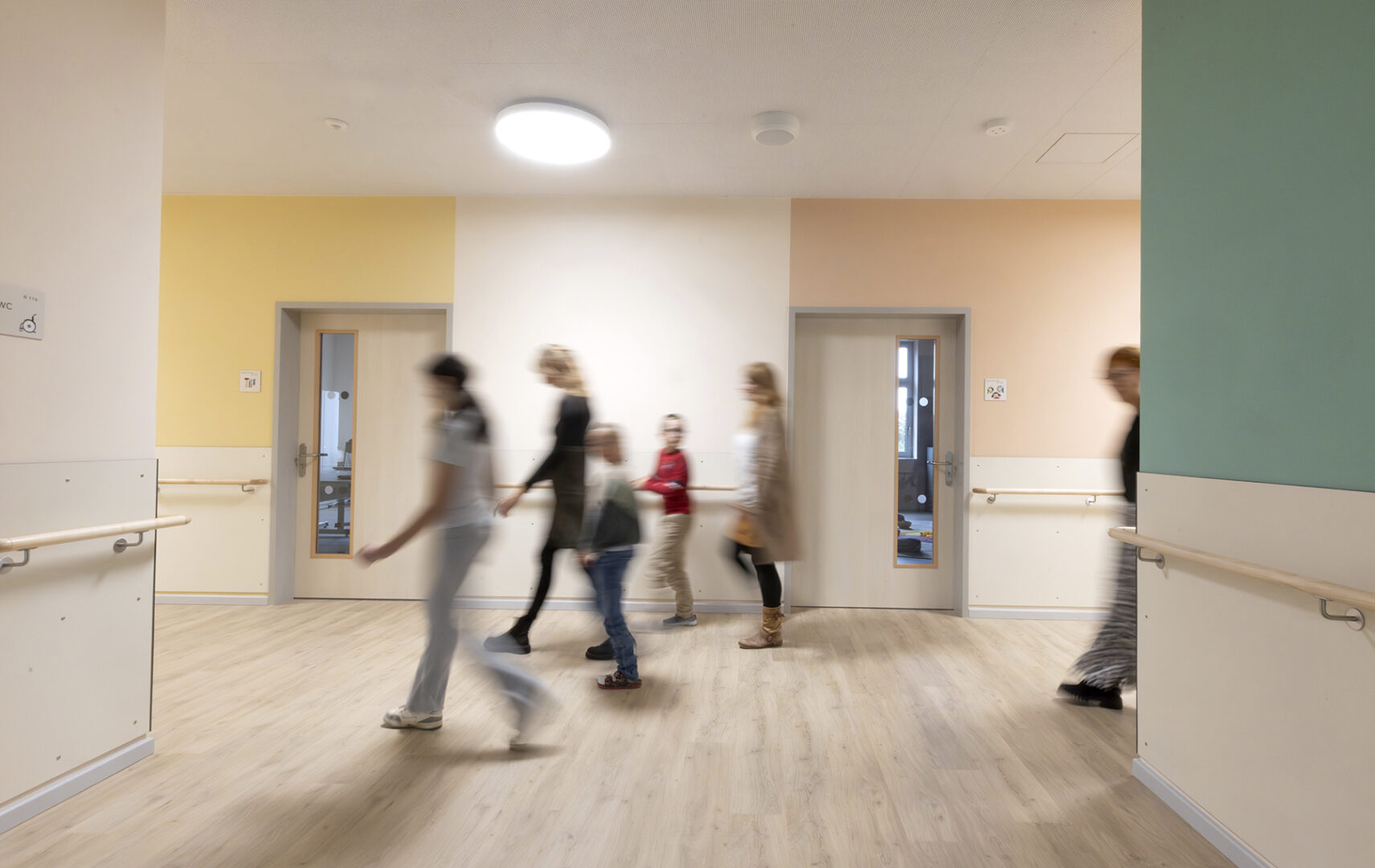
A new study shows that evidence-based color design improves well-being, orientation, concentration, school enjoyment and teacher motivation – without additional costs, but with measurable effects on learning and therapy processes.
Why learning environments are underestimated
What does it take for education to succeed? International educational research largely agrees on one point: the most important factor for learning success is the quality of the teacher. However, this raises a crucial follow-up question: under what conditions can teachers, therapists and pupils develop their potential at all?
Learning never takes place independently of the environment. Spaces influence whether people feel safe, whether they can find their bearings, whether they can calm down, develop confidence or are permanently under stress. Despite this, schools and therapy facilities are still often planned primarily on a functional or economic basis – while the psychological effect of the environment is hardly ever systematically taken into account.
This is precisely where the new study on the MOSAIK school in Grevesmühlen comes in. It examines color not as decoration or a question of style, but as a controllable environmental factor with a direct effect on perception, behavior and motivation.
The MOSAIK school as a real-life experiment
The MOSAIK school in Grevesmühlen is a special school with a focus on mental development. As part of a comprehensive new build, an evidence-based color and lighting concept was developed there, which was scientifically supported by the Institute for Evidence-based Color Psychology at the University of Wuppertal.
The aim was to create spaces that facilitate orientation, promote emotional security, reduce sensory overload and actively support learning and therapy processes. Color was not selected according to decorative preferences, but according to functional criteria: Orientation, concentration, calming, activation and social interaction.
The project was designed to be participatory right from the start. The needs of pupils, parents, teachers, therapists and those involved in planning were analyzed in workshops. Color and material concepts were then developed, which were sampled on site under real lighting and room conditions and adapted several times.
This phase in particular is crucial: colors never work in isolation, but always in combination with light, materiality, room size and usage situation. Often, even a minimal nuance decides whether a room is perceived as calming, stressful or orienting.
The key finding: motivation can be influenced spatially
The results of the study show an exceptionally high level of agreement between all groups surveyed – pupils, teachers, therapists and parents. It is particularly noteworthy that the positive effects affect almost all factors that are crucial for successful educational processes.
88% of pupils report a greater sense of well-being and greater enjoyment of school. Just as many rate learning, concentration and emotional regulation positively. 94% find their way around the building better thanks to the color-coded orientation system.
Parents also notice significant changes. 89% report that their children speak positively about the new rooms. Confidence in the educational quality of the school is just as high. Many parents describe the environment as appreciative, professional and emotionally stabilizing.
Perhaps the most important finding, however, concerns the teachers and therapists themselves. 89% experience the color scheme as a direct support for their educational and therapeutic work. The majority report a greater sense of well-being, a better atmosphere, greater calm and increased motivation in their day-to-day work.
The study thus points to a previously largely underestimated connection: if the quality of the teacher is the most important factor for educational success, then the conditions under which teachers work also become crucial. The MOSAIK study shows for the first time under real conditions that evidence-based color design not only has an effect on students, but can also positively influence motivation, professional identification and social dynamics within an educational institution.
Why the results are scientifically relevant
International interest in the effect of built environments on learning, health and behavior has been growing for years. Studies in environmental and perceptual psychology show that factors such as light, color, orientation, acoustics and stimulus levels have a significant influence on concentration, stress regulation and social interaction.
The MOSAIK study adds a crucial aspect to this field of research: it examines the effect of evidence-based color design not in the laboratory, but in the real everyday life of a sensitive educational-therapeutic environment.
It is precisely this practical relevance that makes the results so relevant. The study shows that design not only creates aesthetic quality, but can also have concrete effects on behavior, motivation and institutional trust.
What the study means for the future of educational spaces
The results of the MOSAIK school make it clear that schools are more than just functional buildings. They are emotional and social environments. Those who plan educational spaces always design the conditions for learning, relationships and participation.
Evidence-based color design is therefore not a decorative add-on, but a previously underestimated tool for supporting educational and therapeutic processes.
The study is an example of the potential that lies in a design that is consistently geared towards human perception and psychological needs. This knowledge will play an increasingly important role in educational and healthcare buildings in the future.
Because good education doesn’t just start in the classroom. It begins with the environment in which people learn, work and meet.
The complete study “Color as a controllable environmental factor in learning and therapy rooms” is published at: DOI: 10.13140/RG.2.2.18963.03367
Download the study free of charge at Research Gate
Download the study free of charge at Academia