
How much health is there in a room?
More than we see—and far more than has been taken into account in many planning processes to date. Interior spaces are not neutral backdrops. Their colors, lighting conditions, materials, proportions, and spatial structures constantly influence how safe we feel, how well we can orient ourselves, whether we can concentrate or relax, and the extent to which our bodies are stressed or supported by the environment.
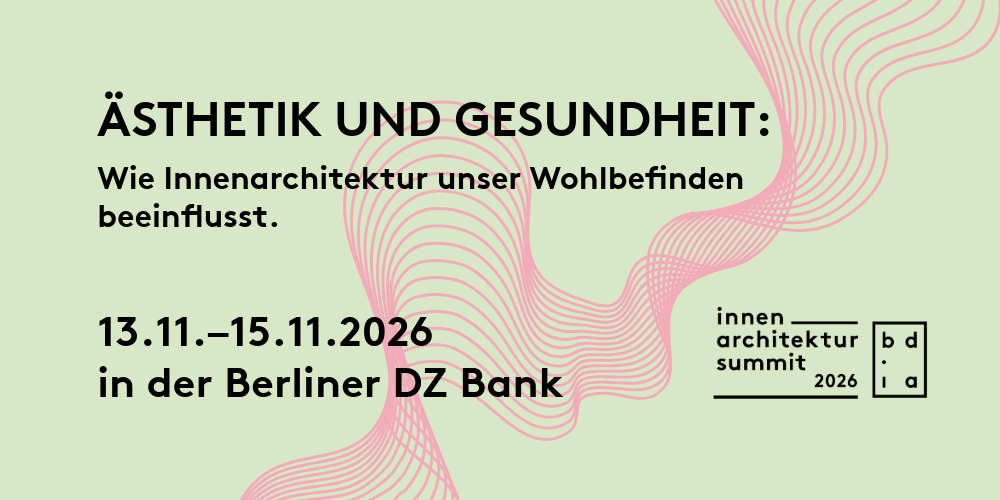
Under the theme “Aesthetics & Health – How Interior Design Influences Our Well-Being,” the 2026 Interior Design Summit will bring together leading voices from interior design, architecture, medicine, psychology, research, and planning practice in Berlin from November 13 to 15. I am very pleased to help shape this pioneering professional conference organized by the bdia—the Association of German Interior Architects—with a keynote address and a master class.
From an Aesthetic Choice to a Health-Related Goal
Interior design is still primarily judged on the basis of formal aesthetic criteria. The discussion centers on whether colors, materials, and shapes complement one another, conform to a particular style, or convey a contemporary impression. These criteria remain important—but they are not enough.
The crucial question is not merely what a space looks like, but above all: What effect does it have on the people who spend time there?
Does it promote a sense of direction and emotional security? Does it support concentration, communication, or recovery? Does it reduce stress and sensory overload? Does it convey a sense of protection and safety? Does it stimulate without being overwhelming? And does it take into account the diverse physical, psychological, and social needs of its users?
Health-promoting interior design begins when such objectives are not merely asserted after the design is complete, but are systematically incorporated into the planning process from the very beginning.
Keynote: Color as a Factor in Health
In my keynote address , “Color as a Health Factor,” I explain why the colors of light and surfaces should not be viewed merely as decorative choices. Colors are a fundamental component of our perceptual environment. They structure spaces, direct attention, facilitate orientation, alter the perception of proximity and distance, and shape the emotional atmosphere of a place.
Their effect is by no means created solely by individual shades of color. What is crucial is the complex interplay of color, brightness, contrast, materiality, light, the function of the space, and the context of use. The same color can have completely different effects in different spatial and social contexts.
Based on my many years of research and the latest work from the Institute for Evidence-Based Color Psychology, I will explain how color design can help to,
To reduce stress,
promote a sense of direction and security,
support concentration and performance,
facilitate recovery and rest,
strengthen communication and social participation,
and create health-promoting environments.
This makes color a key design factor in virtually all areas of interior design: for healthcare and long-term care facilities as well as for workplaces, educational spaces, residential buildings, public facilities, and the renovation of existing buildings.
Master Class: Designing Spaces for People – Translating Impact Goals
The masterclass “Designing Spaces for People—Translating Impact Goals” focuses on the practical application of scientific findings in planning practice.
Terms such as well-being, safety, engagement, comfort, and regeneration are frequently used in design processes. However, it is only once it has been clarified what these goals actually mean for a specific user group, activity, and spatial context that sound design decisions can be made.
Together, we explore how abstract requirements can be translated into clear spatial objectives. Building on this, we develop strategies for tailoring color, light, materials, contrast, spatial organization, and atmosphere specifically to the needs of future users.
Participants will gain insights into current research findings and explore a methodological approach that goes beyond personal preferences, conventional color symbolism, and general impact tables. The focus is on evidence-based, user-centered design, in which decisions are grounded in expertise, communicated within the project, and evaluated in terms of their intended impact.
A Necessary Shift in Perspective in Interior Design
The 2026 Interior Design Summit takes place at a crucial turning point for the discipline. In light of growing mental health challenges, an aging society, new ways of working and learning, and increasing demands on care, prevention, and inclusion, the health impact of interior spaces can no longer be treated as a secondary consideration.
Interior design bears responsibility for people’s living conditions. It can exacerbate stress—or counteract it. It can make it harder to find one’s way—or instill a sense of security. It can exclude people—or enable their participation. It can create institutional coldness—or create spaces where dignity, self-determination, and human connection can be experienced.
This is one of the key challenges facing our profession in the future: not to pit aesthetic quality against health benefits, but to view them as inseparable components of good design.
I look forward to professional exchanges with interior designers, planners, researchers, and everyone who not only designs spaces but also seeks to understand their impact on people and use them responsibly.
Interior Design Summit 2026
Aesthetics & Health – How Interior Design Influences Our Well-Being
November 13–15, 2026
AXICA Congress and Conference Center
in the DZ BANK building
Pariser Platz 3, Berlin
Friday, November 13, 2026
Masterclass:
Designing Spaces for People – Translating Impact Goals
Keynote: “
: Color as a Factor in Health“
Link to register with the organizer bdia