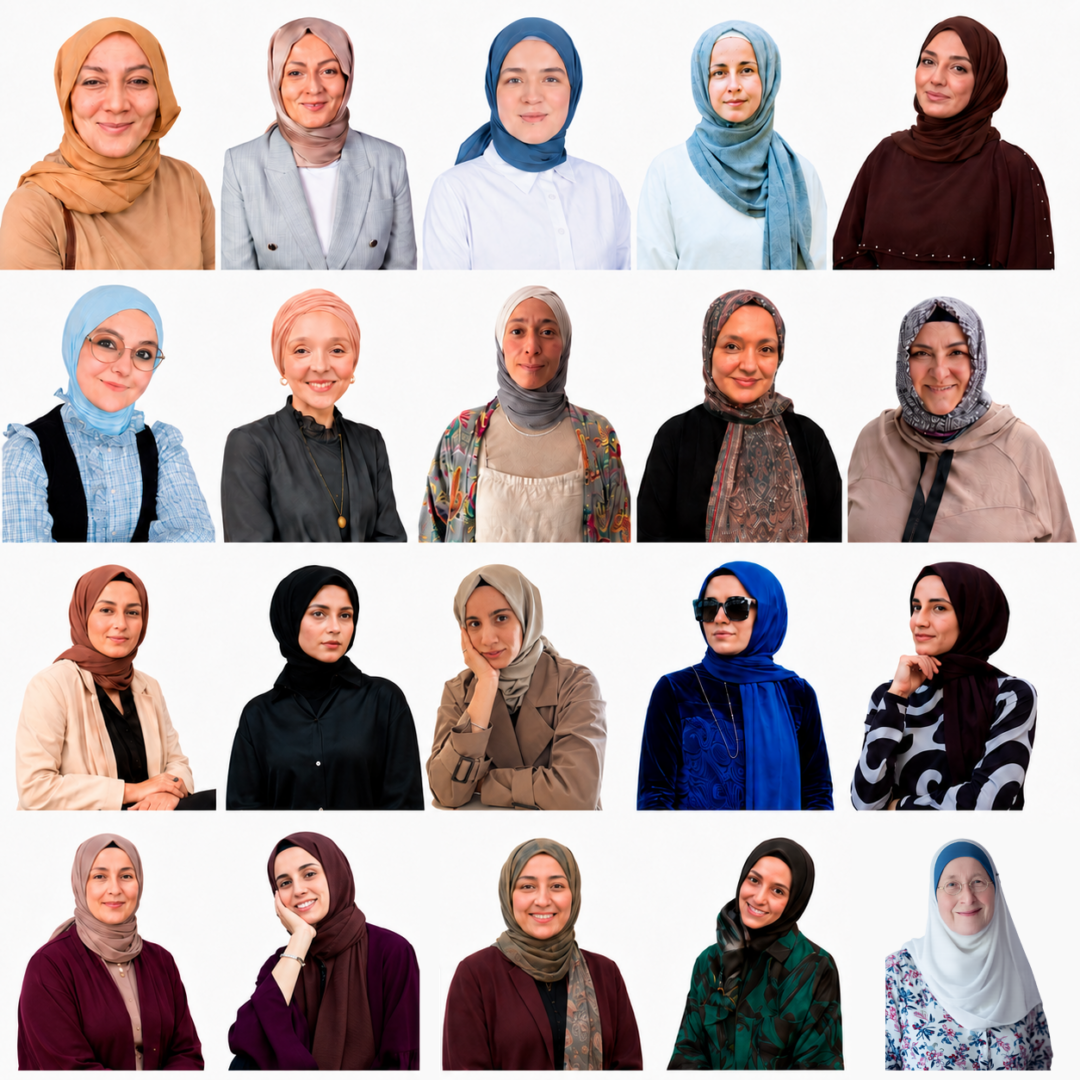
An international study involving 593 Muslim women who wear headscarves from Germany and Turkey yields surprising insights into color, personality, and religiosity
Wuppertal/Berlin, 2026 – What color does a devout Muslim woman wear, and why? In Western social and political debates, the headscarf is often subject to extreme stereotyping and discussed as a symbol of oppression, patriarchal homogenization, or mere conformity. A new groundbreaking study by the University of Wuppertal and the Berlin Institute for Islamic Theology (Humboldt University of Berlin) now empirically challenges these clichés and shows that the choice of color among Muslim women who wear headscarves is not primarily determined by religious precepts. Rather, women consciously use colors to express their personalities, manage their social impact, and adapt their visibility to different everyday situations.
For the study *Colors of Faith*, 593 Muslim women who wear headscarves from Germany and Turkey were surveyed. For the first time, the study systematically examined how personality, religiosity, and social context influence the choice of headscarf color.
The study reveals a finding with explosive sociopolitical implications that directly contradicts common preconceptions: An overwhelming 97 percent of the women surveyed cited only their personal taste as the most important factor influencing their choice of color. Family, religious authorities, social media, and societal expectations, on the other hand, play a completely minor role in everyday life. The key finding: While religious norms do limit one’s freedom of action, they by no means erase individual personality or women’s self-determination.
“We were able to show that personality remains visible even when religious expectations and social norms influence color choices,” says color psychologist Prof. Dr. Axel Buether of the University of Wuppertal. “Colors are not merely decorative details. They are a tool for visual self-expression.”
One finding regarding religiosity is particularly surprising: It is not being white, but being Black that shows the strongest correlation with a pronounced orientation toward taqwa. This central guiding concept of Islamic practice does not describe a rigid dogma, but rather a comprehensive attitude of inner mindfulness, moral integrity, and ethical self-cultivation in everyday life. While white is often associated with purity and spirituality, black apparently stands more strongly in everyday practice for modesty, seriousness, and a consciously reduced visibility.
At the same time, the data contradicts a widespread stereotype: 97 percent of the women surveyed cite their personal taste as the most important factor influencing their choice of color. Family, religious authorities, social media, and societal expectations play a significantly smaller role.
An international comparison also yields remarkable results. Although the formal expression of basic religious orientation among women in Germany and Turkey is at a comparable level, the way this faith is embedded in their everyday lives differs considerably. Women employ entirely different visual strategies within their respective social contexts. While Muslim women who wear headscarves in Germany more frequently use color choices as a means of expressing individuality and openness within the context of a pluralistic society, everyday practice in Turkey is more strongly shaped by traditional patterns of modesty and the visual principle of “not standing out.”
For religious education specialist and theologian Prof. Dr. Tuba Işık, the study thus sends a clear message to the public: “Our data show unequivocally: Muslim women are diverse—one simply has to be willing to recognize this diversity. In light of these findings, generalizations that reduce the headscarf to a homogeneous, one-dimensional symbol are finally a thing of the past.” In practice, the headscarf proves to be a highly complex, multidimensional system of identity. “Faith is actively and aesthetically shaped by these women. The choice of color is not an act of blind conformity, but an internally rooted, independently reflected practice through which women subtly harmonize their spiritual focus, their personal identity, and the demands of everyday life,” Işık continued.
For the first time, this study combines evidence-based color psychology, personality research, and practical Islamic theology within a single research design. The researchers view this as the beginning of a new interdisciplinary field of research: the empirical study of visual self-communication in the context of personality, religiosity, and social context.
Key Findings at a Glance
- Personality remains visible in the choice of colors, even within the framework of religious norms.
- In all areas of life examined, an openness to new experiences correlates with a more expressive use of color.
- Women systematically adapt their choice of colors to different social situations.
- Black—not white—is the color most strongly associated with taqwa in the study, based on empirical evidence.
- 97% cite their own taste as the most important factor influencing their choice of color.
- Despite comparable levels of religiosity, Germany and Turkey differ significantly in their practices regarding color.
- Color choice serves as a form of visual self-expression that reflects one’s personality, religiosity, and social context.
Scientific Information
To download the study: Colors of Faith – Clothing Colors, Personality, and Religiosity Among Muslim Women Who Wear Headscarves in Germany and Turkey
DOI: 10.5281/zenodo.20824510
Download English version Colors of Faith
Press Release from the University of Wuppertal
Authors:
Prof. Dr. Tuba Işık
Islamic Religious Education and Practical Theology | Humboldt University of Berlin
Berlin Institute for Islamic Theology
Prof. Dr. Axel Buether
Institute for Evidence-Based Color Psychology | University of Wuppertal