Keynote Address by Prof. Dr. Axel Buether
On November 20, 2025, the Quadrat Bottrop Museum Center will host the “FARBEN WISSEN” symposium organized by the Essen University of Fine Arts (HBK Essen).
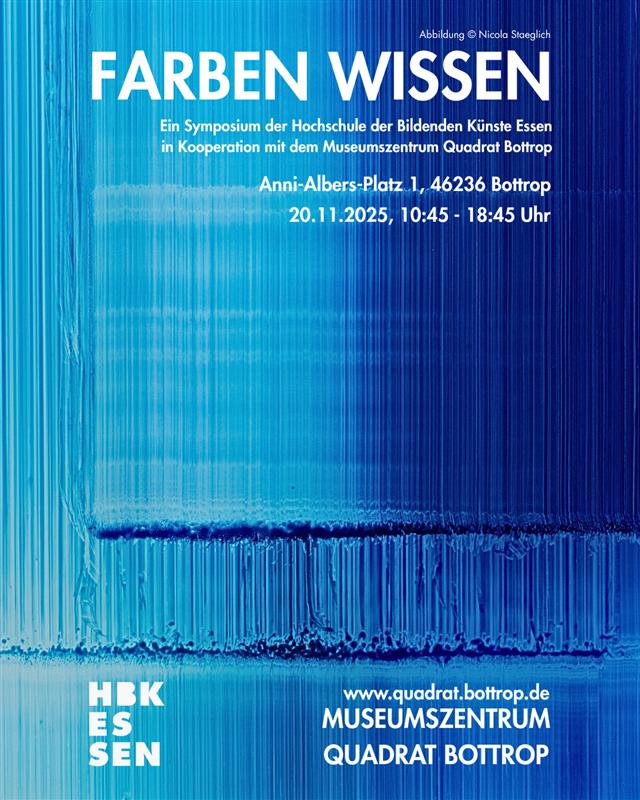
The symposium explores the significance and impact of color at the intersection of science, philosophy, and artistic practice. Through lectures and discussions, it will present diverse perspectives on color as a medium—from its psychological and aesthetic dimensions to its philosophical and art-historical relevance.
Presentations by:
Prof. Dr. Axel Buether, University of Wuppertal
Prof. Dr. Stephan Berg, Kunstmuseum Bonn
Dr. Alexandra Loske, Royal Pavilion, Brighton & Hove Museums
Dr. Linda Walther, Museumszentrum Quadrat Bottrop
Prof. Dr. Sabine Bartelsheim, HBK Essen
Dr. Sarah Sandfort, HBK Essen and Museumszentrum Quadrat Bottrop
Prof. Nicola Staeglich, HBK Essen
Prof. Dr. Luca Viglialoro, HBK Essen
Learn more about the event on the Josef Albers Museum Bottrop website
The colors of nature follow an inner order.
Every nuance, every combination, every shifting light carries information, expression, and meaning.
Those who understand how to interpret this order recognize in it the key to a deeper understanding of life—and of humanity itself.
Color functions as a universal principle of orientation: it structures the visible world, directs attention, and links perception with thought and action.
It structures our experience, providing direction, rhythm, and meaning.
In nature, it determines camouflage and seduction, as well as warning, trust, and belonging.
It gives living beings form and identity, connects them to their environment, and makes them recognizable—to others and to themselves.
In *The Mysterious Power of Colors*, I demonstrated that all artistic and cultural expression is based on these biological foundations.
Color is the largest and most powerful communication system on Earth—in nature as well as in human culture.
It shapes behavior and social interaction long before language emerges, and connects all living things across the boundaries of species and consciousness.
“The Great Book of Color Psychology” opens up the second level: the inner one.
For color does not merely affect the body; it shapes consciousness.
No two people see the same color in the same way.
It evokes memories, reflects attitudes, and connects the past with the present.
What we experience in art is not the color of the image, but the resonance it evokes within us.
Every color has its own character—a spiritual disposition, a way of resonating.
The interplay of these color characters gives rise to the personality of a work of art: its tone, its mood, its voice.
In this way, color becomes the inner resonance chamber of art, where the visible takes on a sense of feeling and the invisible takes shape.
Color is the language of the soul—and at the same time, the key to understanding human nature.
Those who learn to read it realize:
We do not simply see an external world,
but create it within ourselves—from who we are
and from everything we have seen, felt, and remembered throughout our lives.