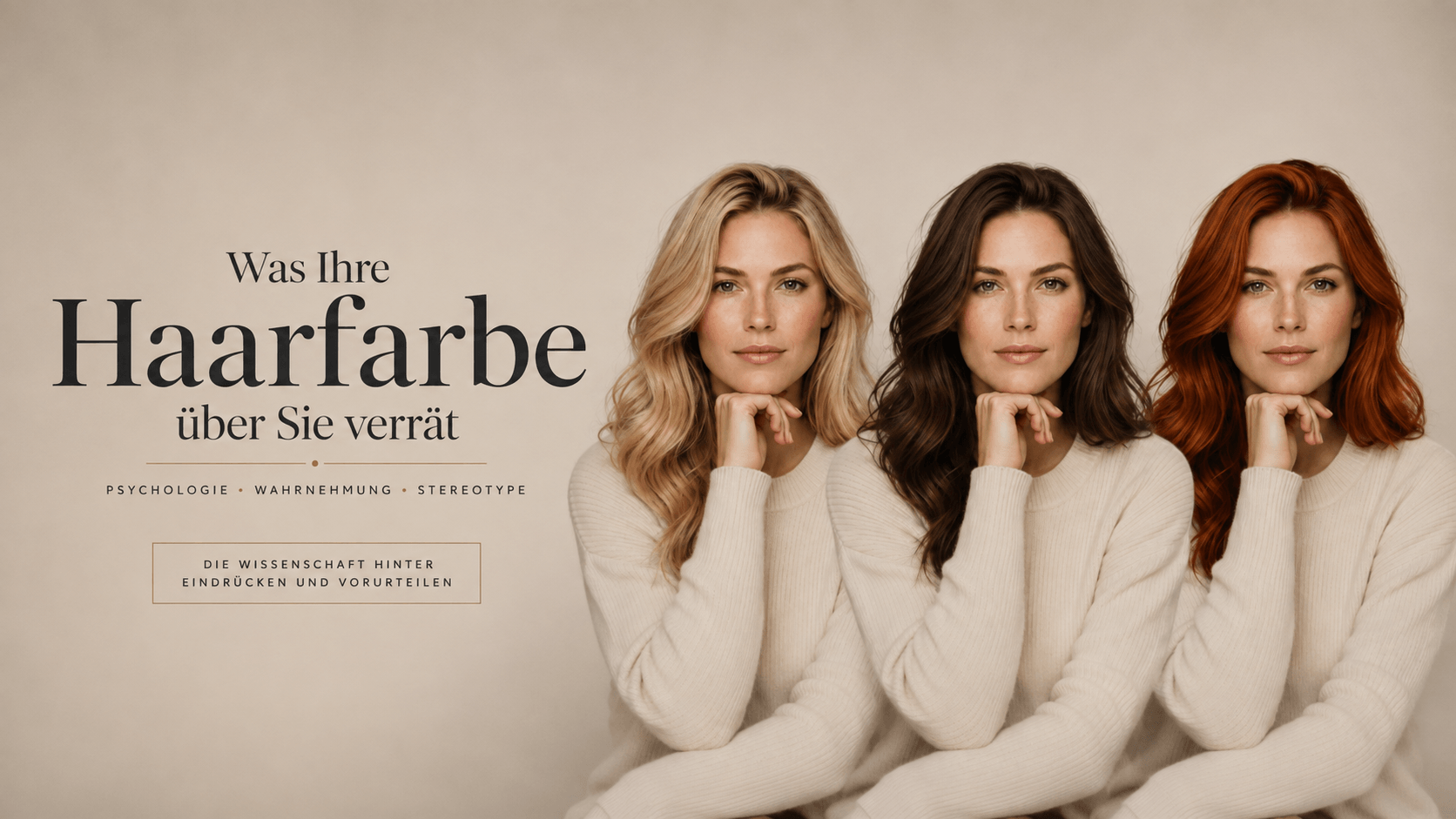
A few years ago, in a British nightclub, the same woman became three different people on three consecutive nights. The same dress, the same face, the same voice, the same laugh. Only one variable changed: her hair color. As a blonde, she was approached by sixty men. As a brunette, forty-two. As a redhead, eighteen.
You might think this is a ranking of attractiveness. But the interesting part of the experiment doesn’t begin until after that. The same photos were then rated—and, of all things, the brunette version came out on top: more attractive, more intelligent, more competent. The blonde version, on the other hand, was rated as more in need of support—as the one most likely to need someone. And it was precisely her who was approached most often.
The researchers believe this is the explanation: People who perceive someone as needing emotional support are less likely to expect rejection. It is not the person’s greater attractiveness that drives the man across the room, but rather his lower inhibition threshold. Hair color did not determine whom the men found more attractive. It determined whom they felt confident approaching.
So there’s a gap between what we think of a person and how we treat them. And that gap is just big enough to fit a color that the woman had no control over.
This is exactly where the misunderstanding begins—the one that has been poisoning the entire debate about hair color and personality for decades. It can be cleared up in a single sentence, and that sentence is so unremarkable that it’s constantly overlooked: A person’s natural hair color says nothing about their character. The hair color they choose, however, certainly does.
That’s not a play on words. That’s the whole difference.
One hundred milliseconds
Our perceptual system isn’t optimized for fairness, but for speed. Anyone who enters a room is categorized before they’ve even uttered a single sentence: In less than a tenth of a second, a judgment is made about their trustworthiness, competence, and likability. What’s troubling about this isn’t the speed. What’s troubling is what happens when you look a little closer. The judgment isn’t revised. It just becomes even more certain.
In that fraction of a second, the brain latches onto the most striking feature available at that moment. And for most people, that’s their hair. It’s the largest contiguous area of color on the body, it sits directly above the face, and it’s visible from thirty meters away. Evolution doesn’t offer a more convenient label.
Just how significant this is was demonstrated as early as 1989 in Ireland. Test subjects were shown the same woman with different hair colors and asked to assess her personality. As a redhead, she was considered significantly more spirited than when she was a blonde or a brunette. Same person, same face, different judgment.
What Judas Has to Do with Your Hairdresser
The meanings of colors are learned, not innate. And they change over time.
Over the centuries, we have imbued the color red with meaning: excitement, danger, passion, and betrayal. In medieval iconography, Judas is depicted with red hair. In the records of the witch hunts, it appears with striking regularity. This meaning still clings to the color today—and we then project it onto the person who happens to have it on their head.
That’s not an inference. It’s a transfer of meaning. We’re not reading the person. We’re reading our own cultural history, which just happens to have settled on her crown.
Then there’s context, and it’s more powerful than the cliché debate is willing to admit. Hair color never stands alone; it always interacts with skin tone, clothing, lighting, and the situation. The same blonde woman is judged differently in a job interview than on a date—this has been proven experimentally. Anyone who thinks they’re reading a person is, in reality, reading a situation. And they’re reading media images: The link between hair color and beauty ideals can be traced across four decades of magazine analysis, and it shifts with every decade.
One detail that’s almost always missing from this discussion: These stereotypes exist almost exclusively in places where hair color varies at all. Worldwide, about ninety percent of people have dark hair. The whole excited typology ranging from blond to red is therefore not a fundamental anthropological law, but rather a regional European phenomenon—arising from a quirk of pigment distribution.
Where It Stops Being Funny
You might think all of this is just small talk. But it isn’t.
Of the five hundred British CEOs surveyed, only five percent were blond—compared to a population share of about twenty-five percent. This is no longer just an anecdote; it’s a significant figure. Hair color stereotypes don’t end in conversation. They end up on resumes.
Each color carries its own cultural baggage. Blonde signals youth and brightness—and is therefore mistaken for naivety. Brown is considered the norm and is therefore mistaken for reliability. Black creates the greatest contrast with the face and thus conveys authority. Red is rare and therefore highly conspicuous—and conspicuousness is the raw material from which stereotypes are made. Gray, finally, is not a marker of character at all, but rather a marker of age: here, we are not evaluating the color itself, but rather a presumed stage of life.
And what about biology? It occasionally produces side effects that look like personality traits but aren’t. In a widely cited study, redheaded women required about nineteen percent more anesthetic to suppress pain responses. A wonderful finding for anyone who has always considered the “pain-sensitive redhead” a fact—except that this is physiology, not personality. And even here, the situation has become contradictory: Recent studies suggest that the genetic variants responsible for these differences in pain sensitivity are different from those that cause red hair.
The Visual Diary
Now for the other half of the story—the part that almost never comes up in public debate.
One’s natural hair color is determined by pigment genetics. A chosen hair color is something categorically different: not a trait, but an action. And personality research is built on actions.
I have been empirically studying this correlation for years. To do so, I recorded the color palettes of people’s everyday clothing and compared them with Big Five personality tests. There is a significant correlation—but it’s not where almost everyone expects it to be.
Two findings surprised even me. The first: It’s not the primary colors that are meaningful, but the shades. Not “blue,” but which shade of blue. The second: Ironically, the favorite color—the one that everyone can name immediately and without hesitation—is the least revealing. It’s usually a projection of our desires—our self-image, not our true self. What matters are the colors we actually wear every day. They are the visual diary of our personality, and we keep it without even realizing it.
That’s exactly why I think this analogy applies to hair color. After all, hair color exists almost exclusively in shades. Ash blonde, copper, platinum, mahogany, caramel—these aren’t primary colors; they’re subtle shades. This places hair color precisely within the range where my data locates personality information.
One difference remains, and it’s an important one: Your wardrobe reflects hundreds of individual choices made over the years. Hair color provides just one. The underlying principle is the same, but the precision is lower. Anyone who draws a diagnosis from this has failed to understand what we’re talking about: it’s about statistical trends. They allow us to make a statement about a thousand people—not about the one sitting across from you.
On the Importance of Conventions
We design our personal style as a cohesive color scheme: clothing, makeup, glasses, phone case, car, apartment. Hair color fits seamlessly into this scheme. It’s not an exception; it’s just one element among many. And this scheme conveys our personality, whether we want it to or not.
There is international evidence that strangers draw accurate conclusions from this. Judgments about a person’s character based solely on full-body photos are surprisingly often accurate, and clothing style proves to be a genuinely valid cue—not a prejudice, but a source of information. Those who choose a visibly non-conforming appearance show, above all, higher scores in a single dimension: openness to experience. Incidentally, the same pattern is also found among people with tattoos.
The direction of the inference is crucial. It leads from the choice to the person—never from birth to the person. The redhead didn’t choose her hair; the color says nothing about her. The girl with pink hair did; it says something about her.
And here’s another point that’s often overlooked in practice: Diagnostically, it’s never the color itself that matters, but rather the deviation from the local norm. Pink was a statement in 1977. In today’s creative agencies, it’s the norm. When a striking color becomes the group norm, its symbolic meaning shifts from openness to conformity. The same color, the opposite message. If you want to interpret color, you must always first interpret the context in which it is used.
The self-fulfilling prophecy
There’s one final twist left, and it’s the most eerie one.
In a Czech study, redheaded women did indeed report more sexual activity than others. A triumph for the stereotype, one might think. However, statistical modeling showed that their own desire did not account for the difference. The effect was due to the behavior of their suitors.
Because we treat people based on their hair color, we often end up creating the very differences that we had previously projected onto them. The stereotype feeds on itself—and ultimately serves as proof of its own existence.
The Last Drawer
Hair color triggers such reliable judgments of character because our brains are not optimized for truth, but for speed. Hair color is immediately visible, easy to describe—and still largely free of social stigma. It is the last major category people are allowed to use in public without having to justify themselves.
The mistake here is not that we draw conclusions about people based on color. We do that all the time, and when it comes to chosen colors, we even do so with a remarkable degree of accuracy. The mistake is that we fail to distinguish between what someone wears and what they were born with.
Drawing conclusions about a person’s character based on their natural hair color is about as reliable as predicting the weather based on the color of a wall. Reading into a person’s choice of color, on the other hand, is not superstition, but rather the psychology of perception.
If you want to try it out for yourself, you don’t need a lab. Open your closet and don’t look at that favorite piece you wear three times a year—look instead at the four items that are constantly in the laundry. Those are your colors. The diary is lying open. You just never looked inside.
This essay was prompted by a request from the BILD editorial staff. The article that appeared there can be found here: How Your Hair Color Affects Other People – BILD
Studies and Sources
Original Research
Buether, A. (2025). The Big Book of Color Psychology: What Colors Reveal About Us and How We Can Use Them in Our Lives. Munich: Droemer Knaur. ISBN 978-3-426-44763-5. Includes a study on the relationship between everyday clothing colors and the Big Five personality dimensions, as well as the color-personality test developed based on this research.
Buether, A. (2020). The mysterious power of colors. Munich: Droemer Knaur.
International Studies
Beddow, J. N. (2011). Hair Color Stereotypes and Their Associated Perceptions in Relationships and the Workplace. Psi Chi Journal of Undergraduate Research, 16(1).
Liem, E. B. et al. (2004). “Anesthetic Requirements Are Higher in Redheads.” Anesthesiology, 101(2), 279–283.
Naumann, L. P., Vazire, S., Rentfrow, P. J., & Gosling, S. D. (2009). Personality Judgments Based on Physical Appearance. Personality and Social Psychology Bulletin, 35(12), 1661–1671.
Rich, M. K. & Cash, T. F. (1993). The American image of beauty: Media representations of hair color over four decades. Sex Roles, 29(1–2), 113–124.
Swami, V. & Barrett, S. (2011). British men’s hair color preferences: An assessment of courtship solicitation and stimulus ratings. Scandinavian Journal of Psychology, 52(6), 595–600.
Swami, V. et al. (2012). Personality Differences Between Tattooed and Non-Tattooed Individuals. Psychological Reports, 111(1), 97–106.
Takeda, M. B., Helms, M. M., & Romanova, N. (2006). Hair Color Stereotyping and CEO Selection in the United Kingdom. Journal of Human Behavior in the Social Environment, 13(3), 85–99.
Tate, J. C. & Shelton, B. L. (2008). Personality correlates of tattooing and body piercing in a college sample. Personality and Individual Differences, 45(4), 281–285.
Weir, S. & Fine-Davis, M. (1989). “Dumb blonde” and “temperamental redhead”: The effect of hair color on certain personality traits attributed to women. The Irish Journal of Psychology, 10(1), 11–19.
Willis, J. & Todorov, A. (2006). First impressions: Forming an opinion after a 100-ms exposure to a face. Psychological Science, 17(7), 592–598.