
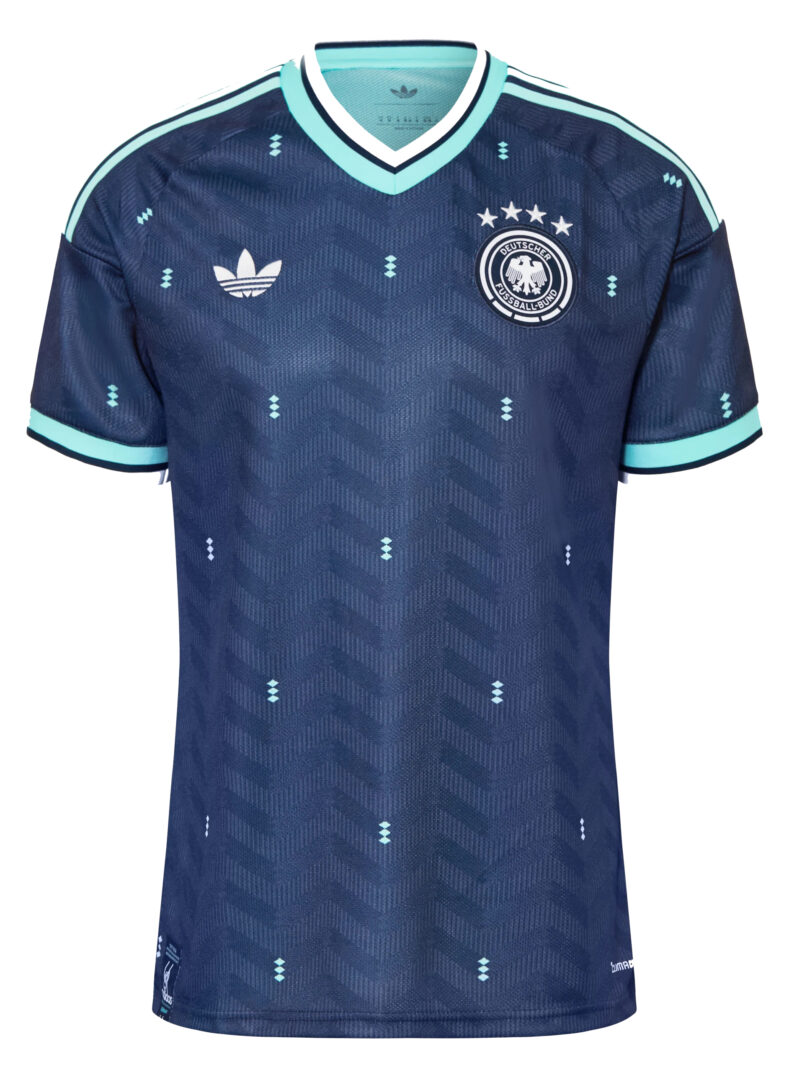
Away jersey of the 2026 Germany national soccer team
When national teams present new jerseys, the talk is usually about design. About patterns, cuts or sales figures. However, the colors often tell the more exciting story. Because colors speak a language that is older than words. They touch feelings before we begin to explain them.
The new away kit of the German national soccer team is a remarkable example of this. At first glance, the color looks familiar. Blue, after all. But if you take a closer look, you realize that it’s not just any blue. It is neither the bright blue of a summer’s day nor the radiant azure of southern coasts. Nor is it the self-confident royal blue that seeks attention and demonstrates strength.
Germany wears navy blue.
That sounds like a nuance at first. In terms of color psychology, however, it is a difference of considerable importance. Sky blue lets you breathe. It opens up the view and conveys expansiveness. Azure blue has a light, optimistic and carefree effect. Royal blue conveys dignity and self-confidence.
Navy blue, on the other hand, is reminiscent of uniforms, jackets, universities, traditional clubs and state institutions. The darker and more muted a blue becomes, the more its psychological effect shifts from freedom to order, from openness to stability, from lightness to commitment.
Navy blue does not promise a new beginning. Navy blue preserves trust.
That’s why the historical reference of the jersey is so interesting. Adidas explicitly refers to blue training tops from earlier decades and to the year 1954, which is not just any old year for German soccer. In 1954, Germany surprisingly won the World Cup. The “Miracle of Bern” became one of the defining myths of the young Federal Republic.
The success meant far more than just a sporting title. In a country that had been in ruins just a few years previously, there was suddenly a feeling of being able to achieve something again. Germany was once again recognized, respected and taken seriously. The economic miracle and the World Cup merged into a single narrative in the collective memory: we’re coming back.
It is precisely this narrative that resonates in the navy blue of the new jersey. Not as a historical fact, but as a feeling.
Colors do not transport the past itself. They transport our idea of it.
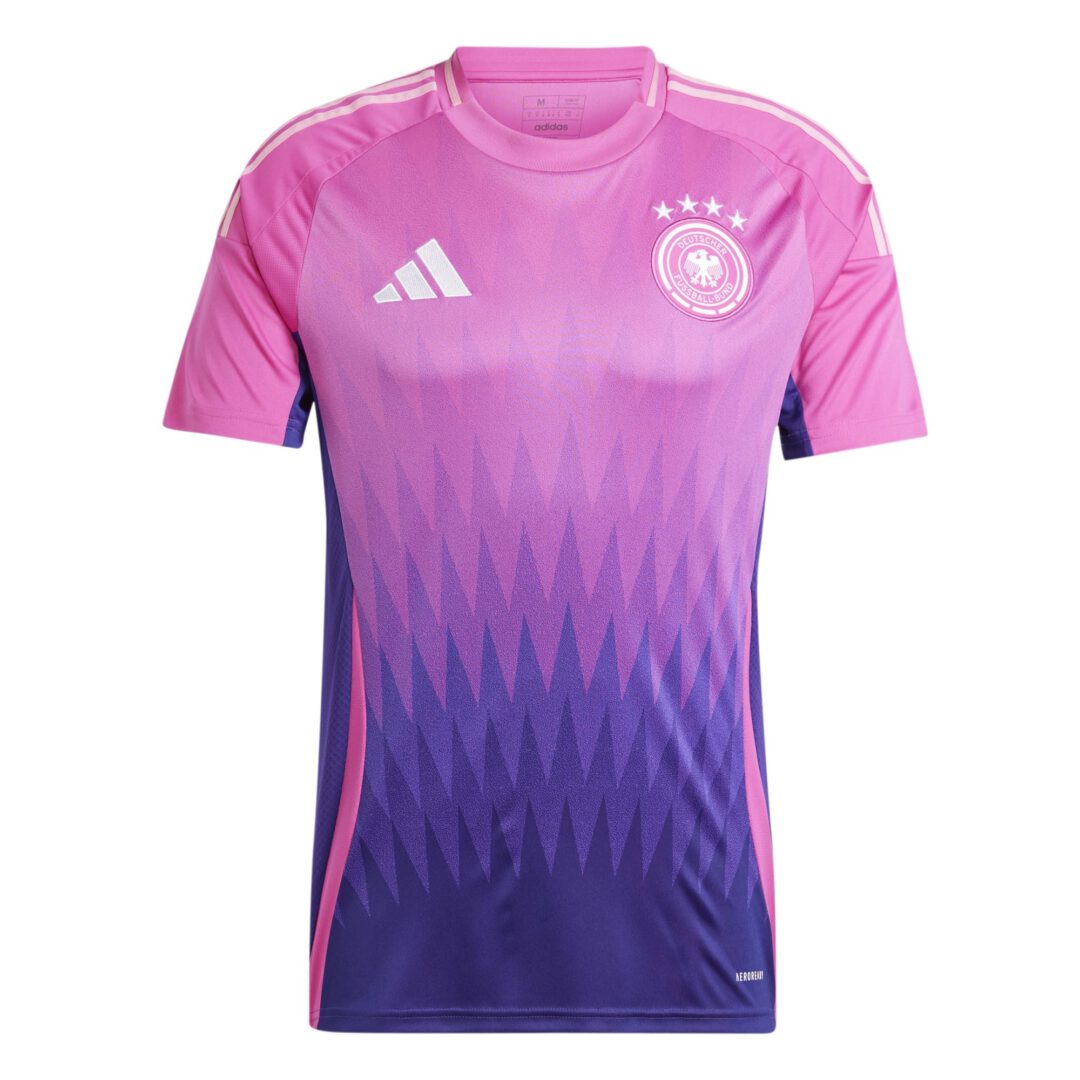
Away jersey of the 2024 German national soccer team
This makes the new jersey remarkably different from its predecessor. The pink away jersey for the European Championship was one of the most discussed jerseys in German soccer history. For some, it symbolized openness, diversity and a new understanding of masculinity. For others, it seemed like a provocation or a break with tradition.
Irrespective of this debate, Rosa embodied something future-oriented. It played with expectations. It irritated. It experimented.
Navy blue does the opposite. It does not seek irritation, but familiarity. It does not invite experimentation, but remembrance. It signals continuity instead of change. This is precisely where its true expressiveness lies.
Interestingly, this is by no means the only conceivable direction. Many national teams today tell their identity through cultural diversity, regional characteristics, progressive patterns or unusual color combinations. They present their nation as something evolving, open and multi-layered.
Germany, on the other hand, opts for a color that refers to something already familiar. That is a difference.
Psychology knows a phenomenon that can explain this development: Nostalgia becomes particularly important when the present and future seem uncertain. It helps people to feel stability when familiar certainties begin to falter. It is less about historical accuracy and more about emotional orientation.
The past appears more orderly, successful and comprehensible than it actually was. Navy blue is an ideal color for remembering.
It combines trust with tradition, stability with seriousness and memory with hope. It is not an aggressive color. It is not a triumphant color. It is a color of quiet confidence. Perhaps that explains why this jersey seems so plausible right now.
It is published at a time when many people feel that the future has become more complicated. Economic uncertainties, geopolitical conflicts, technological upheavals and social polarization have weakened confidence in the grand narrative of progress.
Against this backdrop, navy blue does not appear to be a fashionable choice, but rather a cultural signal.
The new jersey does not look forwards, but backwards. Not out of backward-lookingness, but out of longing. It is reminiscent of a Germany that could tell itself as a story of advancement: recognized in the world, economically successful, full of confidence and convinced that the future would be better than the present.
Whether this past was actually as safe as it appears today is almost secondary. Nostalgia does not work with historical facts, but with emotional images.
This is precisely why this navy blue looks so contemporary.
It tells of a present that is no longer sure of its future and therefore searches in the past for a feeling that it has lost: the confidence that everything could turn out well again in the end.