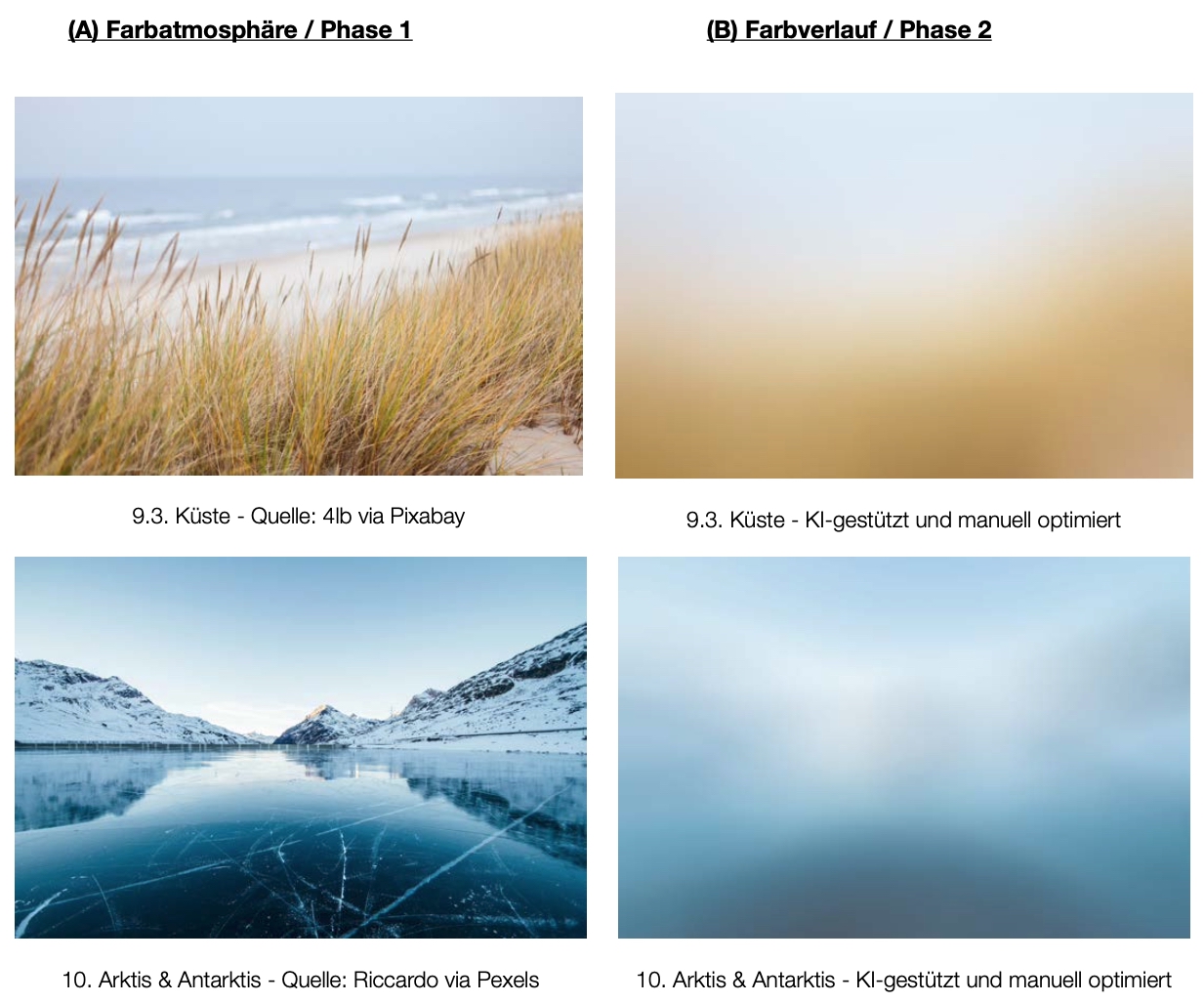
With the newly published open-source study “Color atmospheres as non-verbal access to preferences and behavioral states in forensic psychiatry”, Leila Rudzki and Prof. Dr. Axel Buether present empirical evidence for the first time that color atmospheres can be understood as an independent variable of human perception.
👉 To the study (open access) on Research Gate
Key finding
The study shows:
- Patients with severe communication impairments respond clearly, consistently and reproducibly to visual color atmospheres
- These reactions occur both in representational images of nature and in their abstract color compositions
- The match of the reaction patterns is up to 90 %
This calls into question a central assumption:
It is not primarily the representational quality, but the atmospheric color and lighting mood that seems to be decisive for emotional experience and behavior.
Why this study is relevant
The study was not conducted in a laboratory, but under real-life conditions in a forensic psychiatric ward – with patients who were previously hardly accessible via speech.
The results show for the first time:
- Colors can function as a non-verbal communication medium
- Preferences can be inferred from observable behavior
- Atmospheric design can be used in a targeted manner to:
- Reduce stress
- Reduce aggression
- to promote therapeutic openness
Implications for practice and research
The findings open up new perspectives for:
- Evidence-based architecture and interior design
- Clinical and forensic settings
- Design processes with non-linguistic user groups
- Basic theories of perception and color effects
At the same time, it is an exploratory study with a small sample, which should be seen as a starting point for further research.
A new look at color
The study provides a crucial clue: color atmospheres are a fundamental level of human perception and experience.
It is particularly remarkable that even highly reduced, abstract depictions of color atmospheres – comparable to color field painting – trigger almost the same emotional and physical reactions as representational landscape paintings, provided that the underlying color and light mood is preserved.
This puts the representational nature of visual representations into a new perspective: it is not “what” we see, but “how it works” – the atmosphere – that could be the decisive factor.